Dagmar Havlíčková
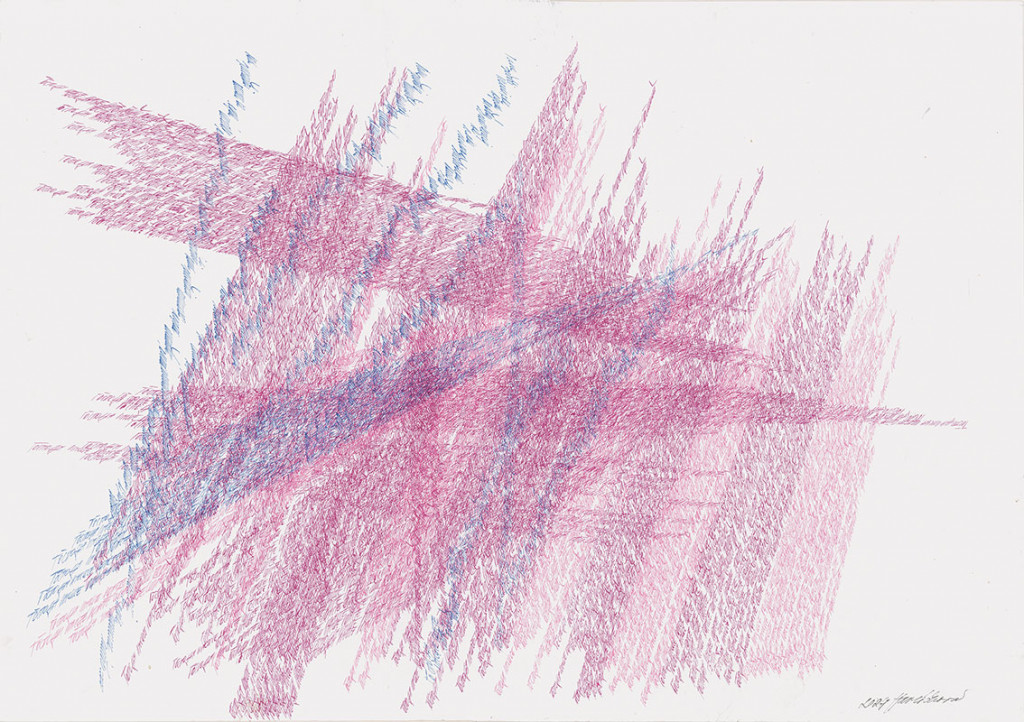
Dagmar Havlíčková’s work emerges from an intense spiritual journey marked by trial, faith, and inner seeking. Trained in graphic design, she has developed a singular practice in which writing, drawing, and textiles become the vehicles of an embodied mystical experience. After a long interruption related to motherhood, followed by a profound existential crisis, her work found renewed momentum in the meditative repetition of prayer verses, transformed into visual mantras. Her compositions, at once fragile and monumental, transfigure language into poetic and spiritual material.
The artist has participated in numerous group and solo exhibitions in the Czech Republic and abroad.
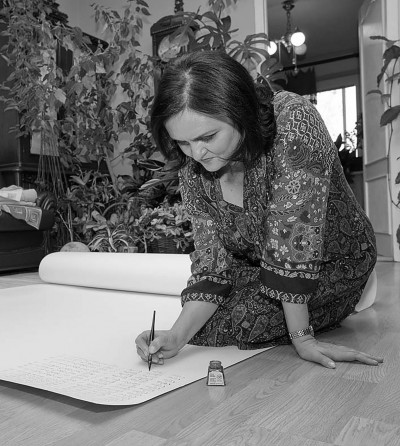
Born in 1961, Dagmar Havlíčková graduated from the Secondary School of Applied Arts in Brno, where she studied graphic design under Ivan and Dalibor Chatrný. She lives and works in Olomouc, a city whose intellectual and artistic circles she engaged with from an early age. Raised in the Orthodox tradition, she developed an interest in spiritual and mystical teachings in her youth, before converting to Christianity at the age of 22.
Following the birth of her two children, she set aside her drawing practice to devote herself to silk painting and to running a small craft business. The sudden death of her husband in 1997 marked a major rupture in her life, leading her into a prolonged inner wandering that culminated in hospitalization. It was through a fervent faith, experienced as a lifeline, that she found the resources necessary to regain inner peace and freedom.
This existential crisis became a decisive turning point in her work. Dagmar Havlíčková then embarked on a vast cycle of drawings based on a single prayer verse, repeated tirelessly until it became the materialization of her inner states. These scriptural chants, sometimes extending several meters in length, require weeks of work. Words intertwine, overlap, and dissolve into palimpsests, at times generating almost kinetic effects.
Like certain practitioners of visual poetry, her work enacts a dissemination of meaning and a dislocation of language. Letters free themselves from their primary function as signifiers to become autonomous forms—sensitive artifacts giving rise to a delicate, deeply poetic, and inhabited body of work.
Alongside her textile practice, she has developed a substantial corpus of free drawings, primarily in monochrome pencil, exploring the fusion of structures and the translation of emotional experiences related to Christianity. This creative freedom also permeates her textile work, where she blurs the boundaries between utilitarian object and autonomous artwork, treating the fabric as a space for drawing—sometimes at the threshold of painting—subtly modulating light and shadow. Her work questions the fundamental need for beauty as a purifying experience and reveals, through a profound exploration of reality, the tension between the outward appearance of forms and their inner organization.