Damián Valdés Dilla
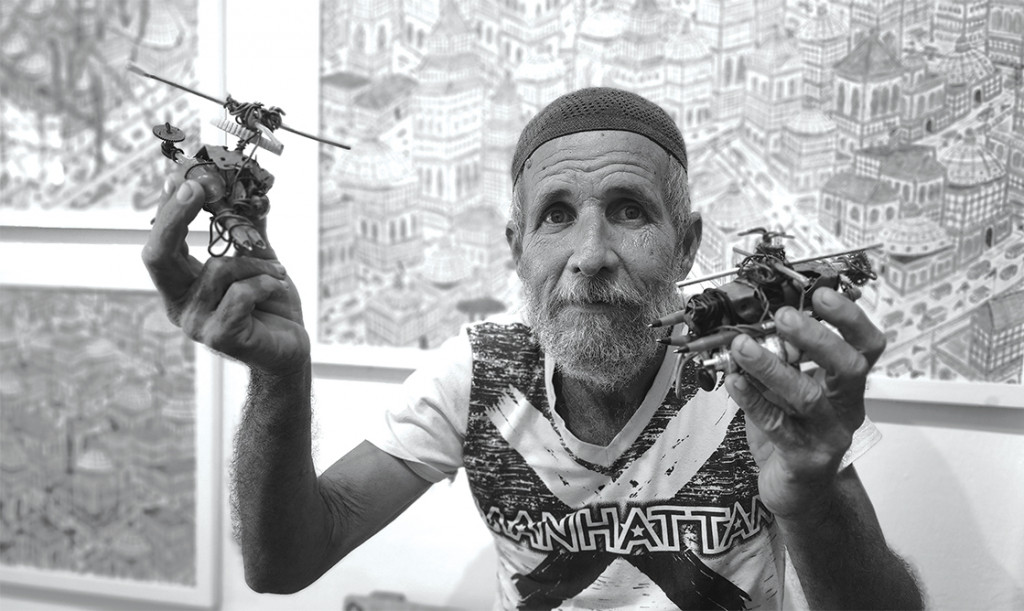
In the work of Damián Valdés Dilla (1970–), the city becomes a mental space, fragmented and recomposed. Using modest materials or drawing, he develops dense architectures, traversed by machines and means of transport. Rooted in the context of Cuban Art Brut, his work emerges from a constrained relationship to space and everyday life. Exhibited internationally since the 2010s, his work is now held in several public and private collections, including that of the Musée national d’Art moderne – Centre Pompidou.
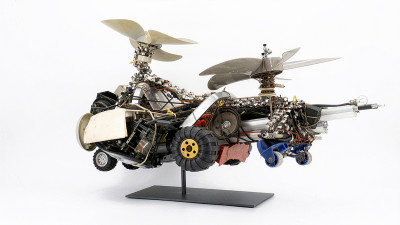
In Damián Valdés Dilla’s work, in Havana, the city becomes a space he traverses without ever setting foot in it. His work emerges from a conflicted relationship with the outside world: anxiety, psychotic episodes, difficulty using public transport, sometimes even crossing a threshold. Rather than narrating this impossibility, he circumvents it. He builds. He organizes. He invents routes, systems, networks, as if architecture and circulation could open a way out. These cities give the illusion of being inhabited, yet remain deserted. Their vitality is concentrated in the architecture and the systems that compose them.
As a teenager, he had already turned to drawing, painting, and collage. Later, he joined a group of self-taught artists in his neighborhood of Alamar, an area to the east of the city, separated from the center by the bay, marked by repetitive housing blocks and a sense of isolation. He distanced himself from it when the context became more risky and closely monitored. This geography matters: for him, the city is not a backdrop, but a daily constraint, a mental framework, a boundary.
Around the age of forty, he began with model-making. Faced with scraps of wood, he assembled a first city. Then came materials from the street: metal, plastic, wires, fragments of objects, remnants of tools, pieces without function. With these elements, he builds towers, factories, churches, hybrid structures. He also constructs vehicles, often in series: buses, cars, airplanes, helicopters, airships, boats, improbable machines. This fascination with transport speaks as much to the desire for movement as to the need to recreate it in miniature.
When materials became scarce, he turned to paper. The transition happened naturally: from three-dimensional cities to drawn ones. His sheets fill with imaginary cities, seen from above, in section, through unstable perspectives. Styles intersect without hierarchy: domes, pagodas, skyscrapers, Art Deco and Art Nouveau motifs. The scenes appear active, sometimes calm, sometimes charged with tension, yet human figures remain absent or secondary, as if the urban itself occupied all the space. Drawing after drawing, he constructs a coherent inner territory, a personal cartography through which one moves with the eyes. Today, his work travels in its own right, exhibited and held in several collections, including the Collection de l’Art Brut in Lausanne and the Musée national d’Art moderne – Centre Pompidou.